An emergency plumber in Caldwell can only start fixing the problem once they reach you, so the minutes before that matter most. Your first job is to stop the water at the nearest valve. Your second is to keep people safe and protect what you can, and your third is to call with clear details.
This guide walks through what to do for each common plumbing emergency: burst and frozen pipes, sewer backups, overflowing toilets, leaking water heaters and the smell of gas. It also covers what to tell the plumber so the visit starts with the right tools.
What counts as a plumbing emergency
Not every plumbing problem needs help tonight. A useful test is whether water or sewage is escaping and you cannot stop it, or whether there is a safety risk. Treat these as emergencies:
- A burst or split pipe, or water spraying from a wall, ceiling or fixture
- Water you cannot shut off at the fixture or the main valve
- Sewage backing up into tubs, showers or floor drains
- Several drains overflowing at once
- A leaking water heater, especially near electrical outlets or finished floors
- Water near electrical panels, outlets or appliances
- Any smell of gas near a water heater, furnace or range
A dripping faucet, a slow sink or a toilet that runs between flushes is a problem worth fixing soon, but it can usually wait for a scheduled visit once you close the fixture’s valve.
Find your shut-off valves before you need them
The main water shut-off valve is the single most useful thing to know about your home’s plumbing. In many Caldwell houses it sits in the garage, a utility room or near the water heater, often where the supply line comes through the foundation. In homes with a crawl space, it may be below the floor near the front of the house. Turn it clockwise to close it. If it is a lever-style ball valve, turn the handle a quarter turn so it sits across the pipe.
Fixture valves let you stop water at one spot without shutting off the whole house. Toilets have a small oval handle on the wall or floor behind the bowl. Sinks have one valve for hot and one for cold inside the cabinet. A tank water heater has a cold supply valve on the pipe at the top.
Valves that have not moved in years can be stiff or can start to drip when turned. Test yours on a calm day. If a valve will not budge, do not force it with a long wrench; a broken valve stem turns a small problem into a large one. Note it and ask a plumber to replace it.
Irrigation is separate. Many Caldwell subdivisions have pressurized irrigation for lawns and sprinklers, run by the Caldwell Municipal Irrigation District. The City of Caldwell’s irrigation page asks homeowners to close their own shut-off valve rather than the city’s curb stop, which should only be closed in an emergency to isolate your system. Know where your private irrigation shut-off is, too.
Burst or frozen pipe: the first ten minutes
When a pipe bursts, speed matters more than anything else. Work through these steps in order:
- Close the main water valve. Do this before you grab towels or call anyone.
- Open a faucet on the lowest level of the house to drain pressure from the lines and slow the leak.
- Cut power to wet areas. If water is reaching outlets, appliances or a breaker panel, switch off the circuit at the panel only if you can reach it while standing on a dry floor. If you cannot, stay out and wait.
- Shut off the water heater if the leak is on its lines: close its cold supply valve and turn the gas control to off or switch off its breaker.
- Move belongings away from the leak and put buckets under drips.
Caldwell winters make this a seasonal risk. Long-term records from the Western Regional Climate Center put the average January low in Caldwell at about 20.5°F. Nights well below that are common during cold snaps. Pipes in crawl spaces, exterior walls and unheated garages freeze first.
Outdoor faucets are a frequent culprit. A hose left connected in fall traps water in the faucet body. When it freezes, the pipe can split just inside the wall, and the damage often stays hidden until spring when the faucet is turned on and water sprays into the wall cavity. Private sprinkler lines are another risk: the City of Caldwell notes that the irrigation district does not provide sprinkler blowouts for private lines, so homeowners need to have their own systems blown out each fall.
If a pipe is frozen but not yet split, you may see frost on it, or a faucet may give only a trickle. Keep the faucet open so melting ice has somewhere to go, and add gentle heat such as a hair dryer or a space heater kept a safe distance away. Never use an open flame. When the leak is behind a wall or under a floor and you cannot see where it starts, pipe leak detection locates it so only the damaged section is opened.
Sewer backup or several drains overflowing
When a toilet, tub and floor drain back up together, the blockage is almost always in the main sewer line that carries everything out of the house. Every gallon you send down a drain has nowhere to go but up through the lowest opening. Act fast:
- Stop using all water in the house: no flushing, showers, sinks, dishwasher or washing machine.
- Pause any appliance mid-cycle.
- Keep children and pets away from wastewater, which can carry bacteria.
- Skip chemical drain openers. They rarely reach a main line blockage and they make the work hazardous for whoever opens the line.
- Find your outdoor cleanout if you know where it is. It is usually a capped pipe a few inches across near the foundation or in the yard.
A plumber will clear the main line from the cleanout and may run a camera to see why it blocked. Roots, sagging pipe and aging clay or cast iron are common causes in older parts of town. If backups keep returning, sewer line services address the line itself, and our guide to sewer line replacement in Caldwell and Nampa explains the options. Homes on septic systems are not covered by this service.
Overflowing toilet
A toilet that keeps rising after a flush needs two fast moves. First, lift the tank lid and press the rubber flapper at the bottom of the tank down onto its seat. That stops more water entering the bowl. Second, close the supply valve behind the toilet by turning it clockwise.
Do not flush again to see if it clears. If plunging does not work, leave the water off and call. A toilet that overflows repeatedly, or one that clogs at the same time as the tub, may be a sign of a main line problem rather than a toilet problem.
Leaking water heater or no hot water
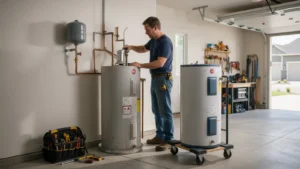
Water pooling around a water heater has a few possible sources: the relief valve discharge pipe, a loose fitting on the supply lines, the drain valve, or the tank itself. Close the cold water valve on top of the heater first. Then turn the gas control knob to off on a gas unit, or switch off the dedicated breaker on an electric unit.
If the water is coming from the tank body, the tank has usually corroded through and will need replacing. If it is coming from a fitting or valve, a repair is often possible. A plumber can confirm which and explain your water heater repair or replacement options.
No hot water without any leak is rarely an emergency on its own, unless it comes with a gas smell. Check whether the pilot light is out on a gas unit or whether a breaker has tripped on an electric one before you call.
If you smell gas, leave first
A rotten-egg smell near a water heater, furnace or range is not a plumbing problem to work on from inside the house. Natural gas has no smell of its own. Utilities add an odorant called mercaptan so leaks can be detected.
Intermountain Gas Company’s emergency guidance tells customers to evacuate, leaving the door open behind them, and then, from a safe location outside and away from the leak, to call the utility’s emergency number at 800-548-3679 and the fire department at 911. While you leave, do not flip light switches, use the phone inside, start a car in an attached garage or do anything that could make a spark.
Once the utility has made the area safe, a plumber can repair or replace the water heater or gas appliance connection that caused the problem.
Protect your home and your records while you wait
Once the water is stopped and everyone is safe, a few steps reduce the damage and make the next conversations easier:
- Take photos and video of the leak, the water on the floor and any damaged belongings before you clean up. Insurance adjusters ask for them.
- Move what you can. Rugs, electronics, boxes and furniture should come off wet floors. Put foil or plastic under furniture legs that must stay.
- Mop and ventilate. Remove standing water with towels or a wet/dry vacuum and open windows if the weather allows.
- Keep receipts for anything you buy to deal with the emergency.
Plumbing repair stops the source of the water. Drying out structures, removing wet drywall and restoring finishes are separate trades and are not part of this service, so ask your insurer how they want that handled.
What to tell the plumber when you call
Clear details on the phone help the plumber bring the right parts and tools. Have this ready:
- Your address and how to get into the property
- What happened, where in the house it started and when you noticed it
- What you have already shut off: main valve, water heater, a fixture valve, power to an area
- Whether water is still flowing
- The approximate age of the home
Age matters more than most callers realize. Older homes near downtown Caldwell and the College of Idaho can still have galvanized steel supply pipe or clay and cast iron sewer laterals, which fail differently from the PEX and PVC in newer subdivisions. Telling the plumber you live in a 1940s bungalow or a 2015 build changes what they expect to find. Homeowners across Caldwell and the surrounding towns can use the same checklist.
Prevent the next emergency before winter
Most of the emergencies above have a cheaper, calmer version you can deal with in the fall. A short checklist each October, before the first hard freeze, removes the most common causes of winter calls in Caldwell homes:
- Disconnect every garden hose and drain it. Close any indoor shut-off that feeds an outdoor faucet, then open the outdoor faucet to let it drain.
- Consider frost-free sillcocks. These outdoor faucets close the valve deep inside the wall where it stays warm. They only work if the hose is disconnected.
- Have private sprinkler lines blown out once the irrigation season ends, since that is the homeowner’s job in Caldwell.
- Insulate exposed pipe in crawl spaces, garages and attics with foam sleeves. Check that crawl-space vents and access doors close properly.
- Open sink cabinet doors on exterior walls during cold snaps so warm room air reaches the pipes, and let a faucet on an outside wall drip on the coldest nights.
- Keep the heat on when you travel. A thermostat set low but steady protects pipes far better than a house left to cool down.
- Label the main shut-off valve and show everyone in the household where it is.
It also pays to look at the water heater once a year. Check for rust or moisture at the base and around the fittings, and make sure the area around a gas unit is clear of boxes and stored chemicals.
Emergency plumbing FAQ
Can I use the toilet or sink while the main water is off?
You can flush a toilet once using the water already in its tank, but it will not refill. If the emergency is a sewer backup, do not flush at all, because the water has nowhere to drain.
Is it safe to stay in the house during a burst pipe?
Usually, yes, once the main valve is closed and no water is near electrical equipment. If water has reached the panel or outlets and you cannot cut power from a dry spot, leave that area and wait for help.
Should I turn off the water heater when the main water is off?
If the house will be without water for a long time, or the leak is on the water heater’s lines, turn the heater off. A tank heater that keeps firing with no water coming in can be damaged, and turning it back on should follow the manufacturer’s instructions.
Get help with a Caldwell plumbing emergency
The order that limits damage is always the same: stop the water, make the area safe, record what happened, then call with details. Knowing where your valves are before anything goes wrong is the habit that pays off most.
One call reaches a Caldwell plumber day or night, and we also connect homeowners in Middleton, Garden City and Nampa with emergency help.
If water is escaping or a drain is backing up, shut it off and call (208) 802-8323 for emergency plumbing help. You will be connected with a local plumber who can talk through the next step and check availability, and you can see the full list of plumbing services covered.