Sewer line replacement cost depends on how much of the line has failed, how long and deep it runs, what sits on top of it, and whether a trenchless method can be used. A camera inspection answers most of those questions. Until a plumber has seen inside the line, any figure is a guess.
This guide explains how to tell when the problem is the sewer line rather than a single drain, what kinds of old pipe sit under older Caldwell and Nampa homes, how the repair options compare, and what to ask before you approve the work.
What a sewer lateral is and who is responsible for it
Every drain in your house, from the kitchen sink to the basement floor drain, feeds into one pipe that leaves the building and runs under the yard to the public sewer main, usually under the street. That pipe is called the sewer lateral or building sewer. Along the way there is normally at least one cleanout, a capped access pipe near the foundation or in the yard where a plumber can reach the line.
In Caldwell, the lateral is the homeowner’s. The City of Caldwell’s sewer fee resolution states that the sewer service connection is considered the property of the sewer user, and that its construction and maintenance are the sewer user’s responsibility. Nampa and most other cities follow a similar approach, though the exact point where private responsibility ends can vary. If you are unsure where your side stops, ask your city’s wastewater department before work begins.
That ownership is why sewer line problems land on the homeowner’s desk, and why a clear diagnosis matters before money is spent.
Warning signs that the sewer line is failing
A single slow sink is usually a local clog in that fixture’s drain. Sewer line trouble looks different, because every fixture shares the same exit pipe. Watch for:
- Toilets gurgling or bubbling when a tub, shower or washing machine drains
- The lowest drain in the house backing up first, often a floor drain or ground-floor shower
- A sewage odor inside the house or around the yard cleanout
- A soggy strip or unusually green patch of lawn between the house and the street
- Clogs that return within weeks of drain cleaning
- Water coming up from the cleanout cap during heavy water use
- Cracks or settling in a driveway or walkway over the line’s path
One sign on its own is a reason to pay attention. Two or more together point strongly to the lateral. Repeated backups are the most reliable signal: if a line has been cleared twice in a year and keeps blocking, something in the pipe is catching debris, and clearing it again only buys time.
When the problem is not the sewer line
Some symptoms that look like a failing lateral have other causes, and ruling them out keeps you from paying for work you do not need.
A gurgling sink with no backups can come from a blocked plumbing vent. Every drain system has vent pipes that run up through the roof to let air into the lines. When a vent is blocked by debris or a bird’s nest, draining water pulls air through the nearest trap instead, which makes the gurgle. The fix is at the roof, not in the yard.
A single fixture that clogs over and over usually has a problem in its own branch line or trap. A kitchen sink that backs up while the bathrooms drain fine points to grease in the kitchen branch, not the lateral. A toilet that clogs on its own may have a worn or obstructed bowl.
A sewer smell in one room can come from a dry trap. Floor drains and rarely used showers lose the water in their trap to evaporation, and that water seal is what keeps sewer gas out. Pouring a few cups of water into the drain often solves it.
The pattern that does point to the lateral is shared trouble: several fixtures affected at once, the lowest drain acting up first, and problems that come back after clearing. A plumber will usually check the simpler causes first, then move to the camera if the evidence points down the line.
Old pipe under older Caldwell and Nampa homes
The pipe material often predicts how a sewer line fails. Homes built in recent decades usually have PVC laterals with glued joints, which resist roots and hold up well. The picture changes in the older parts of both cities. Around downtown Caldwell, Indian Creek Plaza and the College of Idaho, some houses still drain through original clay tile or cast iron. Central Nampa, including the streets around downtown and Lakeview Park, has a concentration of homes built before 1950, and those are the most likely to have original sewer pipe.
Each older material breaks down in its own way:
Clay tile. Vitrified clay pipe resists corrosion, but it comes in short sections joined every few feet. Over decades, the joints shift and open. Tree roots follow moisture to those gaps, grow inside and form mats that catch paper and waste.
Cast iron. Cast iron is strong, but it corrodes from the inside. Rust and scale build up until the opening shrinks, the bottom of the pipe can wear thin, and cracks can run along its length.
Orangeburg. Orangeburg is a fiber pipe made from wood pulp soaked in coal tar pitch, used widely in the years after the Second World War. It was light and inexpensive, but it absorbs water over time, softens, blisters inside and flattens into an oval. Once that happens, the line catches waste and can collapse.
Settled or bellied pipe of any material. Soil movement can leave a low spot, or belly, where waste and water sit instead of flowing. Bellies happen in newer pipe too, often where a trench was not compacted well during construction.
Knowing the age of your home is a useful starting point, but the only way to know the material and condition for certain is to look inside the line.
How a sewer camera inspection decides the repair
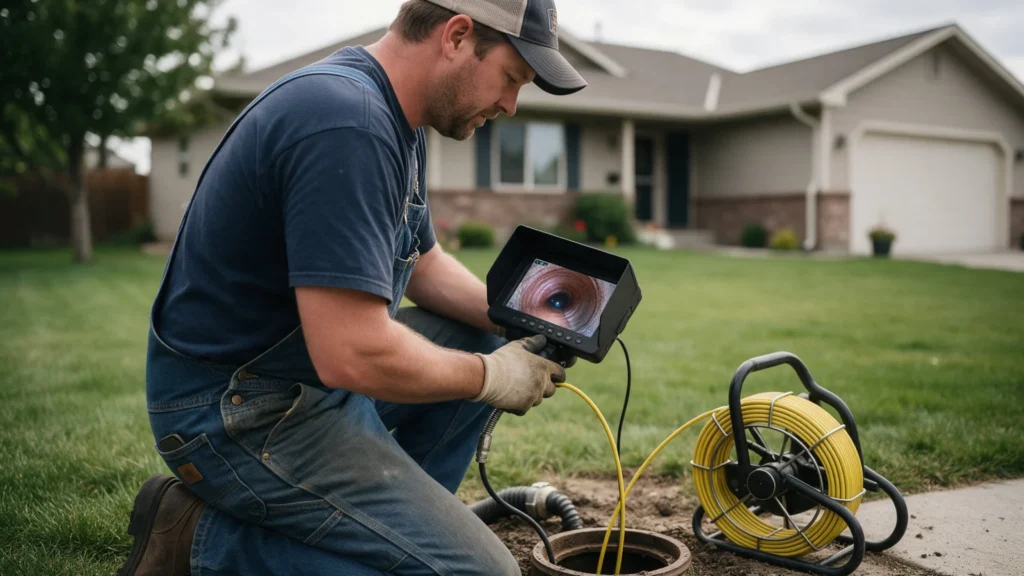
A sewer camera inspection is the step that turns guesswork into a plan. The plumber feeds a waterproof camera on a flexible push rod through a cleanout and records the full run of pipe out to the city connection. On screen, the footage shows:
- The pipe material and any change in material along the run
- Cracks, breaks and missing pieces
- Offset joints where sections have shifted out of line
- Root intrusion and how many joints are affected
- Bellies where water stands in the pipe
- Collapses or sections that have lost their round shape
Many camera heads carry a small transmitter. A locator above ground picks up its signal, so the plumber can mark the exact spot and approximate depth of a problem on the lawn or driveway. That matters for the repair plan and for any digging.
Ask to watch the footage with the plumber and to keep a copy. It is the evidence behind the recommendation, it helps if you want a second opinion, and it is useful to have on file if you sell the home. If you are buying an older house in either city, a camera inspection of the lateral before closing can reveal a problem that a standard home inspection does not cover.
Repair or replace: matching the fix to the damage
The camera footage usually points toward one of three paths.
Spot repair. If the line is sound except for one broken joint, one root-filled section or one short belly, the plumber may excavate or reach that single section and replace it. This makes sense when the rest of the pipe is in good shape and made of a durable material.
Lining or partial rehabilitation. If the pipe has cracks and root entry along a stretch but has not collapsed or lost its shape, a liner may restore it from the inside.
Full replacement. If the line is Orangeburg, badly corroded cast iron, collapsed in places, or failing at many joints, replacing the whole lateral is often the better long-term choice. Patching one spot on a pipe that is failing everywhere tends to lead to the next call.
There is no fixed rule for when replacement wins. The deciding factors are how much of the line is damaged, what the pipe is made of, and how long you plan to own the home.
Trenchless options: pipe bursting and lining
Traditional replacement means digging a trench along the full path of the line, removing the old pipe and laying new PVC. It works with any pipe condition and exposes every section, which is useful when a line has collapsed or needs its slope corrected. The tradeoff is disturbance to whatever sits above: lawn, landscaping, fences, a driveway or a walkway.
Trenchless methods rebuild the line through small access pits instead of a continuous trench:
Pipe bursting. A cone-shaped bursting head is pulled through the old pipe, breaking it outward into the surrounding soil while drawing a new pipe in behind it. The new line follows the old path and can match or sometimes exceed the original diameter.
Pipe lining (cured-in-place pipe). A flexible tube soaked in resin is inserted into the cleaned existing pipe, inflated against its walls, and cured until it hardens into a new pipe inside the old one. Lining avoids digging along the run, though it slightly reduces the inside diameter.
Neither method suits every line. A fully collapsed section, a severe belly, sharp bends or a pipe too small to work in can rule trenchless out or require a combined approach. This is why the camera inspection comes before the choice of method. A plumber offering sewer line services can tell you which approaches fit your line after reviewing the footage with you.
What drives sewer line replacement cost
Without seeing the line, nobody can give a fair figure. You can still understand what moves it, so a quote makes sense when you get one. The main factors are:
- Length of the line from the house to the city connection
- Depth, since deeper pipe means more excavation and shoring
- Method, whether open trench, pipe bursting, lining or a combination
- What sits above the line, such as concrete, pavers, mature trees or landscaping that must be removed and restored
- Pipe material and condition, since a collapsed or bellied line limits the options
- Work at the city connection, which can involve the street or right of way
- New cleanouts, which make future maintenance far easier
- Permits and inspections required by the city
Ask what each quote includes and excludes. Surface restoration is the item most often left out or described vaguely. “Backfill and rough grade” is very different from replacing a section of driveway or relaying sod.
Questions to ask before you approve the work
A good plan is one you understand. Before you sign, ask the plumber:
- Can I see the camera footage and keep a copy?
- What is the pipe material, and where exactly are the problems?
- Is a spot repair realistic, or is the whole line at risk?
- Is my line a candidate for trenchless repair, and if not, why not?
- What will the yard, driveway or walkway look like when the job is done?
- Is a permit required, and who arranges the inspection?
- Will you add a cleanout if the house does not have one?
- What should I avoid putting down the drains afterward?
Comparing two quotes is far easier when both are based on the same camera footage. If a second plumber wants to inspect again, that is reasonable, but sharing the existing video can save time.
Protecting a new or repaired sewer line
A new line can last for decades, but what goes into it still matters. The EPA’s sanitary sewer overflow guidance lists fats, oils and grease, along with household products such as baby wipes and facial wipes, including some marked flushable, as materials that create blockages. The same guidance names tree roots entering through defects or openings in a sewer line as a cause of blockages.
That translates into a few household habits. Wipe grease from pans into the trash before washing them. Keep wipes, paper towels and hygiene products out of toilets. Think about where trees and large shrubs go, since roots search for water and a lateral is a reliable source. Nampa homeowners dealing with recurring kitchen or main line clogs can read our guide to drain cleaning in Nampa for more on what causes them.
Sewer line replacement FAQ
Can roots be cleared without replacing the line?
Often, at least for a while. Cutting or jetting out roots restores flow, but roots usually grow back at the same joints. If the camera shows heavy root intrusion at many joints, replacement or lining is often what stops the cycle.
Can I stay in my home during sewer line replacement?
Usually, yes. You will not be able to use drains while the line is disconnected, so ask the plumber how long the house will be without sewer service and plan around it.
Does homeowners insurance cover sewer line replacement?
Coverage varies widely between policies. Some exclude wear, tree roots and age-related failure, while optional endorsements may cover service lines. Check your policy or ask your insurer before the work starts.
Next steps for a failing sewer line in Caldwell or Nampa
A failing lateral rarely fixes itself, and repeated clearing only delays the decision. Inspecting the line on camera gives you the facts: the material, the damage, the depth and the realistic options. From there, a plumber can price the repair that fits your home in Caldwell or Nampa.
A local plumber in Caldwell can camera the line before any digging starts, and sewer calls from Emmett, Middleton and Star are handled the same way.
If drains across your home are slowing down or backing up, call (208) 802-8323 to arrange a sewer line inspection, or learn more about sewer line repair and replacement. You will be connected with a local plumber who can inspect the line and give you an actual quote. This service covers homes connected to city sewer; septic systems are not covered.