Most leaky faucets can be repaired. In homes across Eagle and Star, the cause is usually a worn cartridge, washer, O-ring or valve seat, and replacing that one part stops the drip. Replacement makes more sense when the faucet body is cracked or corroded, when parts are no longer made, or when the same faucet keeps leaking after earlier repairs.
The decision comes down to where the water is escaping, what kind of valve sits inside the faucet, and how much mineral scale has built up around it. This guide walks through each of those questions in plain terms, so you can tell a simple fix from a failing fixture before you pick up the phone.
How much water does a leaky faucet waste?
A dripping faucet wastes more water than most people guess. The U.S. Environmental Protection Agency’s WaterSense program estimates that a faucet dripping once per second can waste more than 3,000 gallons a year. That is the drip you stop noticing after a week.
Faucets are only one piece of the picture. The same EPA program puts the average household’s leaks at more than 9,300 gallons wasted every year, and it reports that about nine percent of homes have leaks that waste 50 gallons or more per day. Fixing easily corrected household leaks can cut a water bill by roughly 10 percent, according to WaterSense.
The bill is not the only cost. A drip from the spout is harmless to the house because the water goes down the drain. A leak under the sink is different. It soaks the cabinet floor, swells particleboard, and can stay hidden behind cleaning supplies for months. That is why the first job in any faucet repair is finding exactly where the water comes out.
Where is your faucet leak coming from?
Faucet leaks fall into a handful of patterns, and each one points to a different part. Before you take anything apart, watch the faucet for a minute with the water on and again with it off.
- Drip from the spout when the faucet is off: a worn cartridge, washer or valve seat is letting water past the closed valve.
- Water pooling around the base of the spout or handle: the O-rings that seal the spout or the valve body have dried out or flattened.
- Water in the cabinet below: a loose supply line, a worn compression fitting, a failing shut-off valve, the faucet’s own connections, or the drain.
- Weak, sputtering or uneven flow: a clogged aerator at the tip of the spout, or scale inside the cartridge.
- A handle that is stiff, loose or hard to shut fully off: a cartridge or stem that is wearing out.
Leaks under the sink need one more test. Empty the cabinet and dry every pipe and fitting with a paper towel. Run the faucet for a minute, then check again. If the water shows up only while the faucet runs, the drain side is the likely source: the tailpiece, the trap or the drain gasket. If water appears with the faucet off, the supply side is leaking, and that leak never stops. Supply-side leaks deserve prompt attention.
A dry paper towel wrapped around each connection, one at a time, will usually show you the exact fitting. Write down what you find. It helps the plumber bring the right parts.
What kind of valve is inside your faucet?
Every faucet has a valve that opens and closes the water. There are four common designs, and the parts that wear out differ for each one. Knowing which one you have explains why your faucet leaks and what a repair involves.
Compression faucets
Compression faucets are the older two-handle style, where you twist each handle several turns to shut the water off. Inside, a stem presses a rubber washer down onto a brass valve seat. Over time the washer hardens and cracks, and the seat can wear or pit. A drip from the spout usually means a new washer. If the seat is pitted, it needs dressing or replacing too, or the new washer will fail quickly. A leak around the handle usually points to the packing or O-ring on the stem.
Cartridge faucets
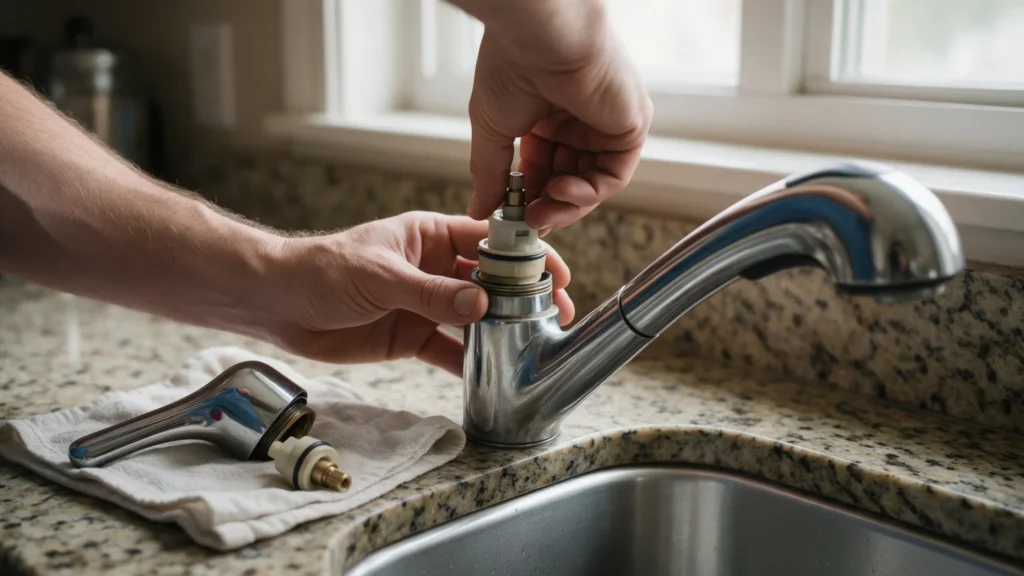
Cartridge faucets can have one handle or two. A plastic or brass cartridge slides into the faucet body and controls both flow and temperature. Most single-handle kitchen and bathroom faucets from brands such as Moen, Delta and Kohler use a cartridge. When it wears, the faucet drips or the handle feels rough. The fix is a new cartridge that matches the faucet model exactly. Cartridges that look alike are often not interchangeable, and a near match tends to leak again within weeks.
Ball faucets
Ball faucets use a single handle that sits on a rounded cap. Inside is a slotted ball, rubber seats and small springs. These faucets have more small parts than other designs, and leaks usually come from worn seats and springs or from O-rings around the spout body. Repair kits exist for most models, but the parts must go back in the correct order.
Ceramic disc faucets
Ceramic disc faucets use two hard ceramic discs that slide against each other to open and close the water. The discs themselves last a long time. Leaks usually come from the rubber seals under the disc assembly, or from grit that scratches the disc faces. Mineral scale can also stiffen the handle and stop the discs from closing tightly.
How does hard water in Eagle and Star wear out faucets?
Hard water is water that carries dissolved calcium and magnesium. The U.S. Geological Survey’s Water Science School classifies water hardness on a simple scale: up to 60 milligrams per liter is soft, 61 to 120 is moderately hard, 121 to 180 is hard, and anything above that is very hard. The USGS also explains that scale from hard water can build up inside pipes and narrow them, which reduces flow and pressure.
Eagle’s water depends on the address. The City of Eagle explains that two utilities serve the city: the City of Eagle Water Department and Veolia, the private utility formerly known as SUEZ. The city says its own testing shows Eagle’s groundwater is moderately hard, and it leaves the choice of a water softener to each homeowner. Some properties on the edges of Eagle rely on private wells instead. Hardness in well water varies from one well to the next, so a recent test result is the only reliable number for those homes.
Star homes are supplied by the Star Sewer & Water District, an independent district separate from the city government. The district draws from deep wells, with its main well reaching about 700 feet, and like most groundwater in the Treasure Valley, that water carries minerals.
Those minerals do their damage in a few specific places inside a faucet:
- Cartridge seals and valve seats. Scale builds up where rubber meets metal or plastic. The seal can no longer close flat, and a slow drip starts.
- The aerator screen. The small mesh at the tip of the spout collects scale and sediment. Flow drops, sprays sideways or sputters.
- Moving parts. Handles feel gritty or stiff as scale coats the cartridge or ball.
- The cartridge housing. Heavy scale can lock an old cartridge into the faucet body. Pulling it out without the right puller can crack the body, and that turns a repair into a replacement.
You can slow this down. Unscrew the aerator every few months and soak it in white vinegar to dissolve the scale, then rinse and reinstall it. Wipe the spout and handle base dry after use in bathrooms where the faucet sees heavy use. Homes with a water softener tend to see less scale on cartridges and aerators, although a softener is a separate decision with its own maintenance.
Why do faucets in newer Eagle and Star homes start leaking?
Star has the newest housing in the Treasure Valley, and much of Eagle was built in the last two decades. Newer does not mean leak-free. Many homes in both towns still have the faucets the builder installed, and those fixtures were chosen for a whole subdivision at once.
Builder-grade faucets often work well for years, then start to drip or leak underneath as their seals wear. In Star in particular, many of these problems show up after the builder warranty has ended, which is when homeowners in Star start looking for a local plumber instead of calling the builder.
New construction also brings installation details that surface later:
- Plastic supply lines that were kinked, twisted or overtightened during construction can start weeping years later at the nut.
- Quarter-turn shut-off valves under the sink are reliable, but a valve that has never been turned may not close fully the first time you need it.
- Faucets mounted without enough support can loosen on the countertop, which stresses the supply connections every time the handle moves.
- Debris from new water lines can lodge in the aerator or cartridge in the first months after move-in.
If your home is fairly new and more than one faucet has started acting up at once, mention that when you call. A pattern across several fixtures can point to something in the supply system, such as high water pressure, rather than one bad part. A plumber can check pressure at a hose bib and tell you whether a pressure reducing valve is doing its job.
What can you safely check before you call a plumber?
Some checks are reasonable for any homeowner. They limit damage and give the plumber useful information.
- Close the shut-off valves under the sink. Turn them clockwise until they stop. If a valve will not turn, or water keeps flowing past it, close the main water valve for the house instead.
- Open the faucet to let the remaining pressure out of the lines.
- Put a towel or stopper in the drain. Small screws and clips vanish down open drains.
- Take photos of the faucet from the front, the handle, and the connections under the sink. Look for a brand name or model number on the faucet base or the underside of the spout.
- Remove and rinse the aerator if the only problem is weak flow. If flow returns, you may not need a repair at all.
Stop there if the cartridge will not come out with gentle pressure, if a fitting is corroded, or if the shut-off valves themselves leak. Forcing a scale-locked cartridge is how a faucet body cracks. Taking apart a faucet with water still in the lines is how a cabinet floods. A plumber has cartridge pullers, seat wrenches and replacement valves on hand for exactly these situations.
Should you repair or replace a leaky faucet?
Repair is usually the right choice when the faucet is in good condition and the leak traces to one worn part. Replacement is worth considering when the faucet itself is the problem.
Repair usually makes sense when:
- The leak traces to a single cartridge, washer, O-ring or seat.
- Replacement parts for the model are still available.
- The finish and body are in good shape, with no pitting or cracks.
- This is the first problem the faucet has had.
Replacement usually makes sense when:
- The faucet has been repaired more than once and keeps leaking.
- The body or spout is cracked, or the finish is pitted and flaking.
- The model is discontinued and matching parts are hard to find.
- The cartridge is fused in place by scale and cannot be removed without damage.
- You want features the old faucet lacks, such as a pull-down sprayer or a higher spout.
Water use is part of the decision too. Under EPA’s WaterSense program, labeled bathroom sink faucets use a maximum of 1.5 gallons per minute, compared with a standard flow of 2.2 gallons per minute. EPA says replacing older bathroom faucets and aerators with labeled models can save the average family about 700 gallons of water a year. If your old bathroom faucet is near the end of its life anyway, that is a reasonable tiebreaker.
Replacing a faucet is also a good time to replace the supply lines and, if they are old or stiff, the shut-off valves under the sink. Braided stainless supply lines and quarter-turn valves make the next repair simpler. A plumber offering faucet repair can handle the repair or the full replacement and confirm every connection is tight before leaving.
What affects the cost of faucet repair?
No single figure fits every faucet, and a plumber gives the actual quote after seeing the fixture. These are the factors that change the scope of the job:
- Valve type and parts. A washer on a compression faucet is a smaller job than rebuilding a ball faucet with several springs and seats.
- Part availability. A common cartridge is easy to source. A discontinued one may need a search or a replacement faucet instead.
- Scale and corrosion. A cartridge locked in by scale takes extra time to remove safely.
- Access. A tight vanity, a deep kitchen cabinet or a wall-mounted faucet adds labor.
- Extra repairs found along the way. Leaking supply lines, seized shut-off valves or a failing drain connection under the same sink are often fixed in the same visit.
- Repair or replacement. A new faucet adds the fixture itself and the installation of new connections.
When you call, ask whether the plumber will confirm the cause before quoting, whether the quote covers supply lines and shut-off valves if they need replacing, and what happens if the cartridge cannot be removed.
Why should you take under-sink leaks seriously?
A drip from the spout wastes water. A slow leak under the sink damages the house. Supply-side leaks run around the clock, and the water collects on the cabinet floor where nobody sees it until the panel swells or a musty smell appears.
Check the cabinet floor for soft spots, stains or bubbling. Press on the panel near the back wall, where water tends to collect. If the cabinet floor is damp but you cannot find the source, or the water bill has climbed with no change in habits, the leak may not be at the faucet at all. A pinhole in a supply line inside the wall can drip into the same cabinet. Pipe leak detection uses tools such as pressure testing and thermal imaging to find leaks that are not visible, so only the spot that needs repair gets opened.
The same logic applies to the toilet next to your bathroom sink. Running toilets and base leaks often show up in the same homes and for the same reasons, and our guide to when a running toilet needs repair covers those checks.
Do tub and shower faucets leak for the same reasons?
Mostly, yes. Tub and shower faucets use the same valve designs: compression stems in older homes, and cartridges or ceramic discs in newer ones. A shower that drips from the head or tub spout after it is shut off usually has a worn cartridge or washer, and hard water scale wears those parts the same way it wears a sink faucet.
The difference is access. The valve sits inside the wall, so the repair goes through the trim plate and handle. Many single-handle shower valves also include a pressure-balancing feature that keeps the temperature steady when someone flushes a toilet. If the shower suddenly runs hot or cold, or the handle no longer reaches full temperature, the cartridge may need cleaning or replacing.
In winter, outdoor faucets add their own risk. A hose left attached to a hose bib traps water that can freeze and split the pipe inside the wall. Our guide to preventing frozen and burst pipes covers how to protect outdoor faucets in Star and nearby towns.
Frequently asked questions
How long does a faucet usually last?
It depends on the faucet’s quality, how often it is used and how hard the water is. Hard water shortens the life of cartridges, seals and aerators, so faucets in homes with more scale tend to need parts sooner. A faucet that needs repeated repairs is usually telling you it is near the end of its life.
Why does my faucet still drip after I replaced the cartridge?
The most common reasons are a cartridge that does not exactly match the model, a cartridge installed slightly out of alignment, or a worn or pitted valve seat. On some faucets, small rubber seats and springs under the cartridge also need replacing. A plumber can check the seat and the part number together.
Can a corroded faucet be repaired?
Light scale on the outside can be cleaned. Corrosion that has pitted the finish or eaten into the body or spout cannot be reversed. In that case, replacing the faucet is the lasting fix.
Do I need to turn off the water to the whole house?
Usually not. The shut-off valves under the sink isolate that faucet. If those valves are seized or leak when you turn them, close the main water valve until the repair is done.
Getting a leaky faucet fixed in Eagle or Star
A dripping or leaking faucet rarely fixes itself, and in moderately hard groundwater the worn parts tend to get worse with each season. Find where the water is escaping, check the cabinet below, and note the faucet’s brand and age. With those details, a plumber can tell you whether one new part will do the job or whether a new faucet is the smarter choice for your home in Eagle or Star.
Outside Eagle and Star, the same local Caldwell plumber handles drips and low flow for homes in Meridian, Garden City and Emmett.
When you are ready, call (208) 802-8323 to book faucet repair and be connected with a local plumber, or read more about faucet repair and replacement first.