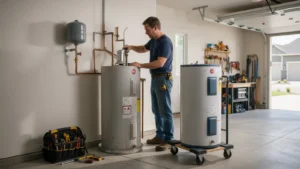
A tankless water heater can be a good fit for a Meridian or Eagle home, but only when it is sized for how your household uses hot water and maintained for the water you actually have. Hard water is the deciding factor. The same minerals that leave white crust on faucets build up inside a tankless unit’s heat exchanger, and that buildup shapes both the upkeep and the long-term tankless water heater cost.
The upfront price depends on three things more than the unit itself: whether your gas line, venting and electrical service can support the new heater, how much hot water you need at the same moment, and how you plan to manage scale. A local plumber gives the actual quote after seeing the space. This guide explains what drives that number, what hard water does to a tankless system, and the questions to ask before you decide.
How hard is the water in Meridian and Eagle?
Meridian’s water is hard, and the level depends on where you live. The City of Meridian’s 2025 water quality report lists a system average of 9.19 grains per gallon, or about 157 milligrams per liter. The city splits its system into five zones, and they differ a lot. Zone 4 came in lowest at 6.97 grains per gallon. Zone 1 was highest at 10.53 grains per gallon, about 180 milligrams per liter.
To put those numbers in context, the U.S. Geological Survey classifies water by its hardness in milligrams per liter. Water from 61 to 120 counts as moderately hard, 121 to 180 counts as hard, and anything above 180 is very hard. By that scale, most Meridian zones sit firmly in the hard range, and Zone 1 is right at the line where hard becomes very hard.
One detail can confuse homeowners. The city’s general water FAQ gives a long-run average of about 7 grains per gallon. The annual report is the more current snapshot, and it shows the system running harder than that average. If you are planning equipment, use the annual report figure for your zone.
Eagle is more mixed. The City of Eagle says two utilities serve the city, each with its own service area: the City of Eagle Water Department and Veolia, formerly known as SUEZ. Which one supplies your home depends on your address. The city describes its own groundwater as moderately hard and leaves the choice of a water softener to the homeowner. Some properties on the edges of town use private wells, and well water can be much harder or softer than city water. If you are on a well, find your most recent test results before you talk to a plumber about a tankless unit.
What hard water does inside a tankless unit
A tank water heater stores water and lets sediment settle to the bottom. A tankless heater works differently. Cold water flows through a compact heat exchanger, and a gas burner or electric element heats it as it passes. Nothing is stored, so there is no tank to fill with sediment. The trade-off is that the heat exchanger has narrow passages, and that is where scale collects.
When hard water is heated, calcium and magnesium come out of solution and cling to the hottest surfaces. In a tankless unit those surfaces are the walls of the heat exchanger. A thin layer of scale acts like insulation. The burner or element has to work harder to push heat through it, and the unit’s sensors start to see temperatures they do not expect.
The warning signs build slowly:
- Hot water that swings between hot and lukewarm during a shower
- Less hot water flow at a fixture than when the unit was new
- Error codes that point to overheating, flow or ignition problems
- Rumbling, ticking or other noises that were not there before
- A unit that shuts down during long showers or when two fixtures run at once
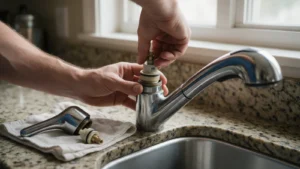
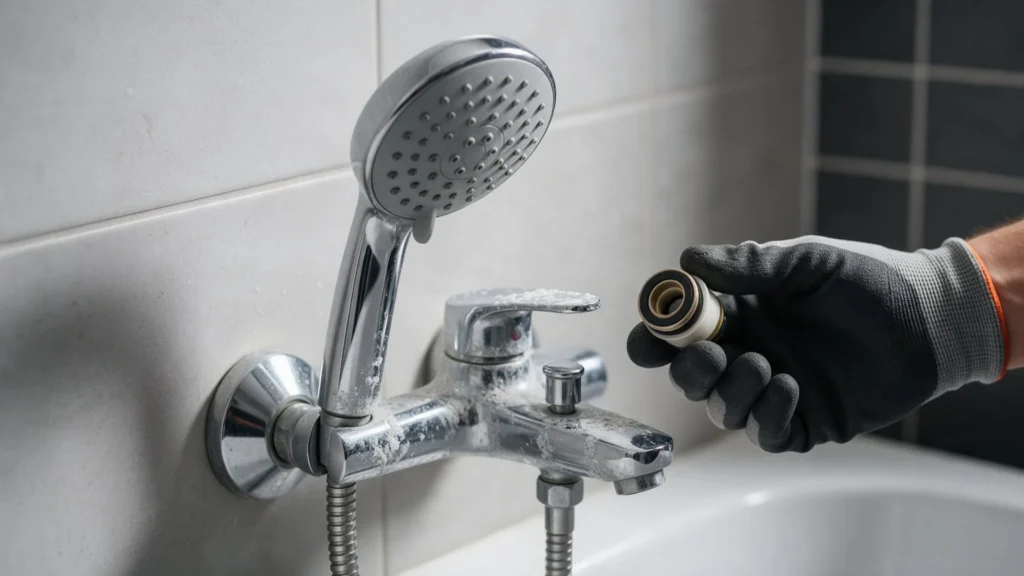
Scale also shows up outside the heater. The aerators on your faucets and the cartridges inside them collect the same minerals, which is why low flow at one sink often has a simple cause. If that is the issue you are dealing with, faucet repair is usually the right call rather than a new water heater.
Descaling: the maintenance that makes or breaks tankless in hard water
Descaling, often called a descaling flush, is the routine that keeps a tankless heater healthy. A plumber closes the isolation valves on the hot and cold lines, connects a small pump and hoses, and circulates a descaling solution through the heat exchanger. The solution dissolves the mineral layer. The unit is then flushed with clean water, the inlet filter screen is cleaned, and the heater is put back in service.
Manufacturers such as Rinnai, Navien, Noritz and Bosch all call for periodic descaling in their owner’s manuals. The interval in the manual is a minimum. In Meridian’s harder zones, or on a well with high hardness, the heater may need flushing more often than the booklet suggests. A plumber can look at the amount of scale that comes out during the first flush and set a schedule from there.
Three things make descaling easier and cheaper over the life of the heater:
Isolation valves. These are service valves on the water lines right below the unit. Without them, each flush takes longer because the plumber has to add a way to connect. Many installers include them as standard, but it is worth confirming.
A water softener or scale-reduction system. Softened water slows scale a great deal. Some homeowners use a scale-reduction filter instead of a full softener. Either one changes how often the heater needs attention. A softener is a separate piece of equipment with its own upkeep, so treat it as part of the overall plan rather than an afterthought.
A sensible temperature setting. Scale forms faster at higher temperatures. Setting the heater no hotter than your household needs helps.
Skipping descaling is the most common reason tankless units in hard water fail early. If you already have a tankless heater that is throwing error codes or losing flow, a plumber who handles water heater repair can check whether a flush will bring it back or whether a part such as a sensor or the heat exchanger itself has failed.
Sizing a tankless heater: flow rate and temperature rise
Tank heaters are sized in gallons of storage. Tankless heaters are sized by flow rate, measured in gallons per minute, and by how much they can raise the temperature of the incoming water. That second number is called the temperature rise.
The two numbers work together. A heater can deliver more gallons per minute when the incoming water is already fairly warm and fewer when it is cold. Incoming water is usually colder in winter, so a unit has to lift the temperature further in January than in July. A heater sized only for summer conditions can fall short on a cold morning when two showers and the dishwasher run together.
A plumber will usually ask:
- How many bathrooms you have and how many showers might run at the same time
- Whether you have a large soaking tub that needs a lot of hot water at once
- Which appliances use hot water, such as a dishwasher or clothes washer
- How far the farthest fixture is from the heater
- Whether anyone in the household takes long showers back to back
From those answers the plumber works out your peak demand, the most hot water you use in a single moment. The heater is sized around that peak rather than your average use. In larger homes, the answer is sometimes two units working together instead of one large one.
Distance matters for comfort too. A tankless heater does not deliver hot water to a faucet any faster than a tank does. The water still has to travel through the pipes, so a fixture at the far end of the house waits the same as before. Some homeowners add a recirculation option to shorten that wait.
Gas lines, venting and electrical capacity
Installation work, not the heater itself, is usually where the biggest differences in tankless water heater cost come from. Every home is different, and these are the parts a plumber needs to see in person.
Gas supply
A gas tankless water heater burns a lot of gas for short periods. At full fire it can demand far more than the tank heater it replaces. The existing gas line from the meter may be too small to supply that demand while the furnace, range and dryer are also running. When it is, the line has to be upsized. Gas line sizing depends on the length of the run, the number of fittings and every other gas appliance on the line, so it cannot be judged from a photo. The gas meter itself may also need to be checked by the gas utility.
Venting and condensate
Most gas tankless units need their own vent. Condensing models, which pull extra heat from the exhaust, can often vent through plastic pipe but produce acidic condensate that needs a drain. Non-condensing models run hotter exhaust and need vent material rated for it. Where the old tank sits decides how easy the vent is to route. A heater in a garage on an outside wall is a very different job from one in an interior closet.
Electrical service
Electric tankless units avoid gas lines and venting, but a whole-home electric model can draw a large amount of current. It often needs dedicated circuits, and some older or smaller electrical panels cannot support it without an upgrade. Gas units need power too, for their controls and fans, so a nearby outlet is part of the plan.
Location and permits
Moving the heater to a new location means new water, gas, vent and drain connections. Keeping it close to where the tank was usually means less work. Water heater replacement and new gas work often require a permit and an inspection, and the plumber handling the job can explain what applies.
What drives tankless water heater cost in your home
There is no single price that fits every Meridian or Eagle home, and any figure you see online is a national average that may not reflect your house. These are the factors that move the number up or down:
- Unit capacity: a higher flow rate costs more than a smaller unit.
- Condensing or non-condensing: condensing units are more efficient but usually cost more and need a condensate drain.
- Fuel type: gas units usually need more installation work, while large electric units may need panel work.
- Gas line upsizing: a longer or larger new line adds labor and material.
- Venting: a short, straight vent run is simpler than a long one through a finished space.
- Conversion or replacement: replacing an existing tankless unit reuses most of the setup, while converting from a tank does not.
- Water treatment: a softener or scale filter is a separate item.
- Permits and haul-away: removing the old tank and any required inspections are part of the job.
Running cost is the other half of the picture. A tankless heater avoids standby loss, the heat a tank loses while it sits waiting. That is where most of the energy savings come from. Real-world savings are not fixed, though. A U.S. Department of Energy Building America field study found that a tankless gas heater should save about 33 percent on water heating compared with a conventional storage heater, but actual savings varied with how much water each draw used. Efficiency came close to the rated figure at draws of 10 gallons or more and dropped for short draws, because the heat exchanger loses some heat each time it cools down. The greatest savings came at about 50 gallons of hot water a day.
That finding matters for planning. A household that runs lots of quick hand washes and short rinses will see less benefit than one with longer showers and full loads. Lifespan helps balance the higher upfront cost. ENERGY STAR gives a life expectancy of about 20 years for gas tankless units, longer than a typical tank, provided the unit is maintained. In hard water, that maintenance is what makes the long lifespan realistic.
Incentives change from year to year. Before you buy, ask your gas or electric utility whether it offers a rebate on high-efficiency water heaters, and check what federal and state programs apply at the time.
Questions to ask before you approve a tankless quote
A clear quote makes it easier to compare options. These questions are especially useful in hard-water homes:
- What flow rate and temperature rise is the unit sized for, and what does that mean for my busiest morning?
- Does the existing gas line need to be upsized, and is that included?
- How will the unit be vented, and where will the vent exit the house?
- Are isolation valves for descaling included?
- How often do you recommend flushing the unit on my water, and is the first flush part of the job?
- Do you recommend a softener or scale filter for my zone or well, and is it priced separately?
- Is a permit needed, and who arranges the inspection?
- What happens to the old tank?
Ask for the answers in writing. Two quotes that look far apart are often covering different work, and the list above makes that easy to spot.
When a new tank makes more sense than tankless
Tankless is not the right answer for every home. A standard tank can be the smarter choice when the gas line, vent and panel would all need major work, when the household rarely uses much hot water at once, or when nobody wants to keep up with descaling. A tank still needs care in hard water. Annual flushing and checking the anode rod help it last longer.
It also helps to confirm that the old heater is really the problem. Sometimes a tank that seems to be failing is fine, and the real issue is elsewhere. A water heater that runs constantly, for example, can be a sign of a hot water leak under a slab or behind a wall, and pipe leak detection can rule that out before you replace anything.
Frequently asked questions
Can a tankless water heater run out of hot water?
It will not run out the way a tank does, because it heats water as it flows. It can fall behind if too many fixtures run at once for its flow rate. Correct sizing for your peak demand prevents that.
Do I need a water softener with a tankless heater in Meridian?
It is not required, but most Meridian zones have hard water, and a softener or scale filter slows buildup in the heat exchanger. Without one, plan on more frequent descaling. Your plumber can suggest an approach based on your zone.
Is tankless a good option for an Eagle home on a private well?
It can be a good fit for an Eagle home on a well, as long as the well delivers steady pressure and flow and you know the water’s hardness. Share your latest well test with the plumber so the unit and any treatment can be matched to it.
Will a tankless heater fix low water pressure?
No. A tankless unit cannot raise the pressure coming into the house. Low pressure at every tap usually points to the supply line or the pressure reducing valve, which should be checked separately.
Plan the right water heater for your water
Whether you are in Meridian, Eagle, Nampa, Boise or Emmett, a Caldwell plumber can size a tankless unit for your household before you commit.
Tankless heaters work well in Treasure Valley homes when they are sized for real peak demand, installed with the gas, vent and service valves they need, and flushed on a schedule that matches the water. In Meridian that schedule depends on your zone, and in Eagle it depends on whether you are on city water, Veolia or a well. To talk through a tankless upgrade, a failing tank or a unit that keeps losing heat, call (208) 802-8323 to be connected with a local plumber or read more about water heater repair and replacement.